
For business, farm & acreage
Commercial, Farm & Acreage Solar in Edmonton
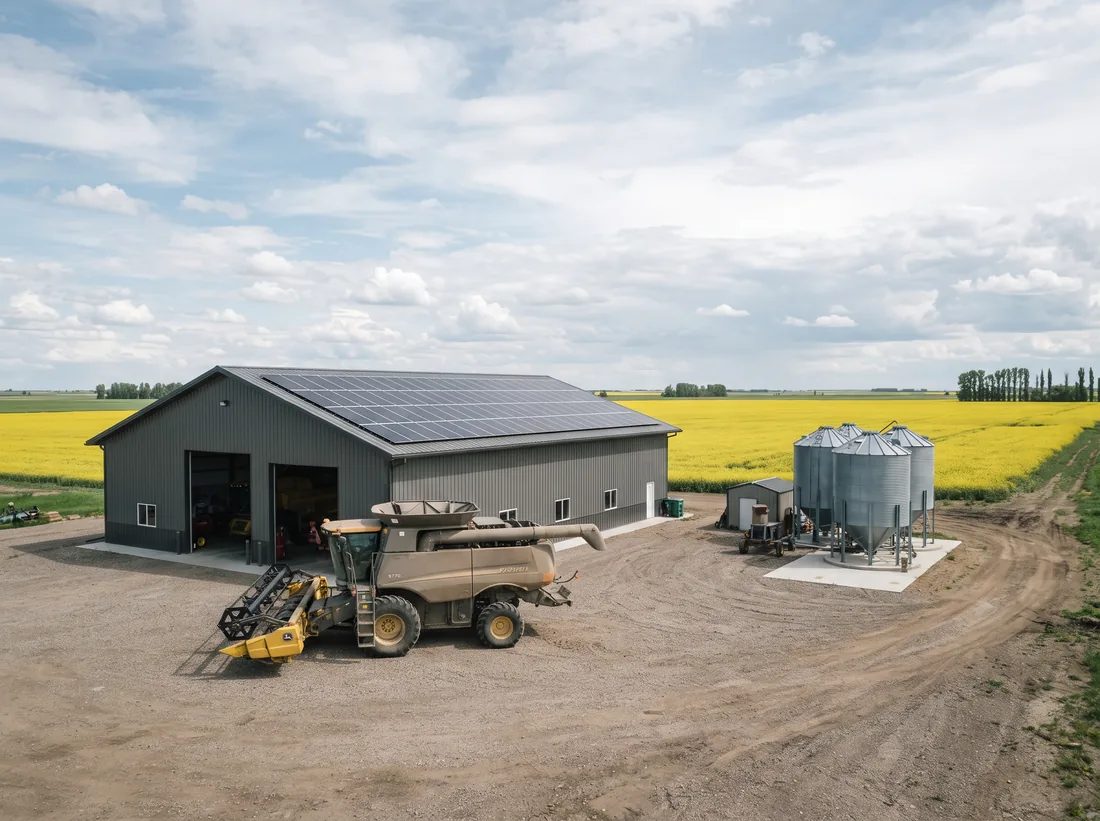
Warehouses in the industrial parks, shops and grain-drying sites on Capital Region farms, acreages with room for a ground mount. Big roofs, open land and daytime load make some of the best solar sites in Alberta.
Solar for Edmonton Businesses, Farms and Acreages
A commercial power bill has two parts: the energy you use, and on larger accounts, charges tied to your peak demand. A warehouse, shop or farm that runs through the day uses power when panels make it, so more of the output offsets energy you would otherwise buy.
The industrial parks along the Yellowhead and in Nisku, retail and office roofs across the city, and the shops, barns and grain-drying sites on farms in Parkland, Sturgeon, Leduc and Strathcona counties share the same advantages: wide roofs or spare ground, and daytime load.
For incorporated businesses and farms, the federal Clean Technology Investment Tax Credit can return up to 30% of the cost of qualifying solar equipment, subject to the labour conditions and eligibility rules. Your accountant confirms whether you qualify; we give them the numbers they need.
Alberta’s micro-generation rules apply up to 5 MW. Systems under 150 kW are credited at your retail energy rate; larger ones at the hourly wholesale price, which changes how we size them.
Call 250-250-2525 with a recent power bill and we can usually give you a rough system size over the phone.
What’s included
What a Commercial Project Includes
Load and demand analysis
We look at when you use power, not just how much. Interval data shows how much of the output you will use on site, and that sets the size.
Roof or ground-mount design
Older barns and pole sheds weren’t built for extra load. On farms and acreages a ground mount is often cheaper to maintain, easier to clear of snow and produces more.
Structural engineering
Before anything goes on a commercial roof, we confirm it can carry the added dead load plus Edmonton snow load, with an engineer’s sign-off where required.
Three-phase electrical and interconnection
Three-phase work by licensed electricians, permits pulled, and commissioning to EPCOR’s or FortisAlberta’s interconnection requirements.
Tax credit and paperwork support
Equipment lists, costs and in-service dates organised for your accountant’s Clean Technology ITC claim, plus the micro-generation application.
Backup for critical loads
Optional battery storage for refrigeration, controls, grain-drying fans or a server room, so a July storm doesn’t stop the work.
Pricing
Commercial Solar Costs
| System size | Suits | Installed cost |
|---|---|---|
| 25 kW | Shop, small office, farm yard | $55,000 – $70,000 |
| 50 kW | Warehouse, retail building, grain-drying site | $100,000 – $130,000 |
| 100 kW+ | Large industrial or agricultural site | from $190,000 |
Before any tax credit. Price per watt falls as systems grow, but structure, electrical service and mounting vary far more between commercial sites than between houses. Every commercial price follows a site assessment.
Commercial systems usually pay back faster than residential ones: more output is used on site, pricing improves at scale, and an eligible corporation can recover up to 30% through the federal tax credit, plus capital cost allowance. Ask your accountant how both apply, alongside our numbers.
Why us
Why Businesses and Farms Work With Us
Load modelled, not guessed
Many proposals size to roof area. We size to the share of output you will actually use.
Farms and acreages are routine
Shops, barns, bins and wells, with an honest call on when the ground beats the roof.
Tax credit organised
Your accountant gets clean records for the ITC claim, not a shoebox of invoices.
One point of contact
From the first bill review to commissioning, you deal with one person.
Daytime load is the advantage
A shop, warehouse or farm uses most of its power in daylight, when panels produce. That means less is exported and more is used directly to offset energy and delivery charges.
Edmonton’s long summer days line up with the busiest months for many businesses: construction yards, greenhouses, grain handling and cooling loads. We model your load against the monthly output so the system is sized for what you will actually use.
Process
How a Commercial Project Runs
Bill and load review
Twelve months of use and demand data, often enough for a first estimate of size.
Site and structure
Roof, electrical room, three-phase service and available ground.
Design and payback model
System size, output, demand impact, tax credit and payback, in writing.
Permits, build, commissioning
Wire-owner coordination, installation, inspection and handover.
Commercial timelines depend mostly on structural review and wire-owner approval. You get a realistic schedule with the quote.
Areas we serve
Commercial, Farm & Acreage Solar across Edmonton and the Capital Region.
Our other services
- Residential Solar Panel InstallationRooftop solar sized to a year of your bills, built for Edmonton snow and hail.
- Off-Grid Solar SystemsStand-alone power with batteries and generator backup, sized for January rather than June.
- Solar Battery Storage & Backup PowerBackup for essential circuits when the power goes out, added to new or existing solar.
- Solar Panel Repair, Snow & MaintenanceOutput diagnosis, inverter replacement, hail inspections and cleaning, on any installer’s system.
Find out what solar would do to your power bill.
A free estimate starts with a short phone call. No pressure, no obligation, and a straight answer either way.
250-250-2525Have these ready
- A year of power bills or the “kWh used” line from each. Twelve months tells us more than anything else.
- Your address, so we can check roof direction, pitch and shade on satellite imagery.
- A photo of your electrical panel with the door open. It shows whether an upgrade is needed.
- Plans for an EV, heat pump, hot tub or garage suite, so the system is sized for them.